Natacha Métayer Human Factors Team Leader
“Employee Stories”: Natacha Métayer shares her career path and daily life at VEDECOM
Can you tell us about your background before joining the institute?
I completed all my studies at Rennes 2 University, specializing in psychology. I defended my PhD there in 2016, in cognitive psychology and ergonomics. My work focused on the comprehension of illustrated educational documents, with a particular focus on eye-tracking strategies during learning. After my PhD, I worked at several universities, and then in January 2019, I had the opportunity to join VEDECOM as an R&D engineer, focusing on themes related to interactions between vulnerable road users and automated vehicles.
Why mobility in particular?
Because it is a subject that concerns us all, regardless of our geographical location: in rural, suburban, or urban areas. Mobility remains a very important lever for autonomy and social inclusion, values that truly matter to me. It was therefore in line with what I wanted to do.
How did you become a team leader?
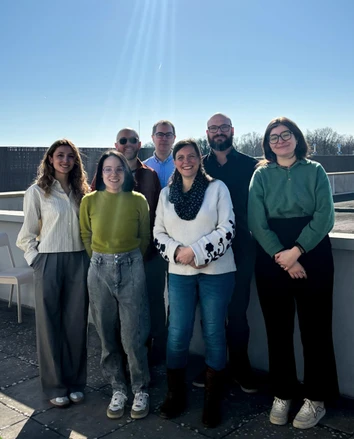
Gradually. When the previous manager left the institute, the position was opened internally. I applied and got the position, taking office in September 2021. Today, the team consists of ten people: Aïsha, Anna, François, Gaëtan, Lucie, Nicolas, Stéphane, Théa, Thomas, and myself.
And how did you discover this position?
I was subscribed to specialized psychology mailing lists where job offers were posted. One day, I saw an ad: “Cognitive Psychology Researcher, VEDECOM Institute, Versailles.” Reading the description, the desired profile was someone in cognitive psychology who works on eye movements and is interested in interface comprehension. I thought to myself: that’s me! The subject was centered on mobility, but I had already used the theoretical concepts involved in my PhD and previous experiences.
How would you describe your mission as a manager?
It is twofold. On one hand, there is local management: supporting employees on a daily basis, ensuring they have all the resources to work in good conditions, helping them develop their skills, and helping them plan their professional growth. On the other hand, there is business development: setting up new projects to ensure the team’s funding, acting as a liaison with management, and maintaining relationships with external stakeholders to identify collaboration opportunities. Additionally, I am also a project manager on certain projects: a dual role that brings even more responsibilities.
Do you remain involved in the research itself?
Not directly, no. But I do so indirectly through project development, methodological reflections on themes I know well, and especially the supervision of PhD students. I am the VEDECOM scientific advisor for several theses, alongside authorized thesis supervisors from partner laboratories. And I still have a few articles pending publication: it’s just a matter of prioritization given the current workload!
What profiles make up your team and how do they complement each other?
That is truly the strength of the team: extremely varied profiles. We have researchers in social, cognitive, and neuropsychology, as well as in ergonomics, and even a designer and a profile from a marketing background.
“It’s easy to work with them: they are always motivated, always full of great ideas.”
This diversity allows us to approach the same question from very different angles, and that is what makes our responses original and relevant for our partners. When we talk about human factors, a human being is multifaceted; therefore, several perspectives are needed to fully understand them.
Added to this are varied methodological skills: qualitative and quantitative approaches, physiological measurements, and tools like virtual reality, with our pedestrian walking platform and our driving simulator.
Are there any skills you would still like to strengthen within the team?
Always! What would be most useful is not necessarily opening new fields, but rather having redundancy in existing expertise. Even when you have one person in social psychology, depending on their training and background, they won’t approach the same theories or methodologies as another. Having multiple perspectives on the same field is a real asset. We could also imagine strengthening biomechanics or ergonomics, but honestly, we can always go further.
Tell us about the June 11 event: Mobility Decrypted.
Mobility Decrypted is the event dedicated to the field of Mobility Uses and Impacts. The objective is to give visibility to the activities in this field. The day is divided into two parts. The morning is dedicated to our project partners: we present the results of projects ending this year and highlight the work of our research teams and PhD students. In the afternoon, we open to a wider audience: current partners, occasional collaborators, prospects, local authorities, ADEME, and ANR to show them our methodologies, our tools, and what the skills in this field can bring to their mobility issues. We plan demonstrations so they can truly experience it from the inside, with the human factors and sustainable mobility economics teams. The idea is to say: come see what we can do, let’s talk, and we will support you on your projects because mobility is not just a technological issue.
Any final words?
What deeply motivates me is the chance to work in an institute that blends technical sciences with human and social sciences. It is this complementarity that creates our entire value. And besides, I have a wonderful team! Committed, competent, enthusiastic employees, always full of great ideas. Honestly, it makes the job of a team leader much easier.