No Results Found
The page you requested could not be found. Try refining your search, or use the navigation above to locate the post.
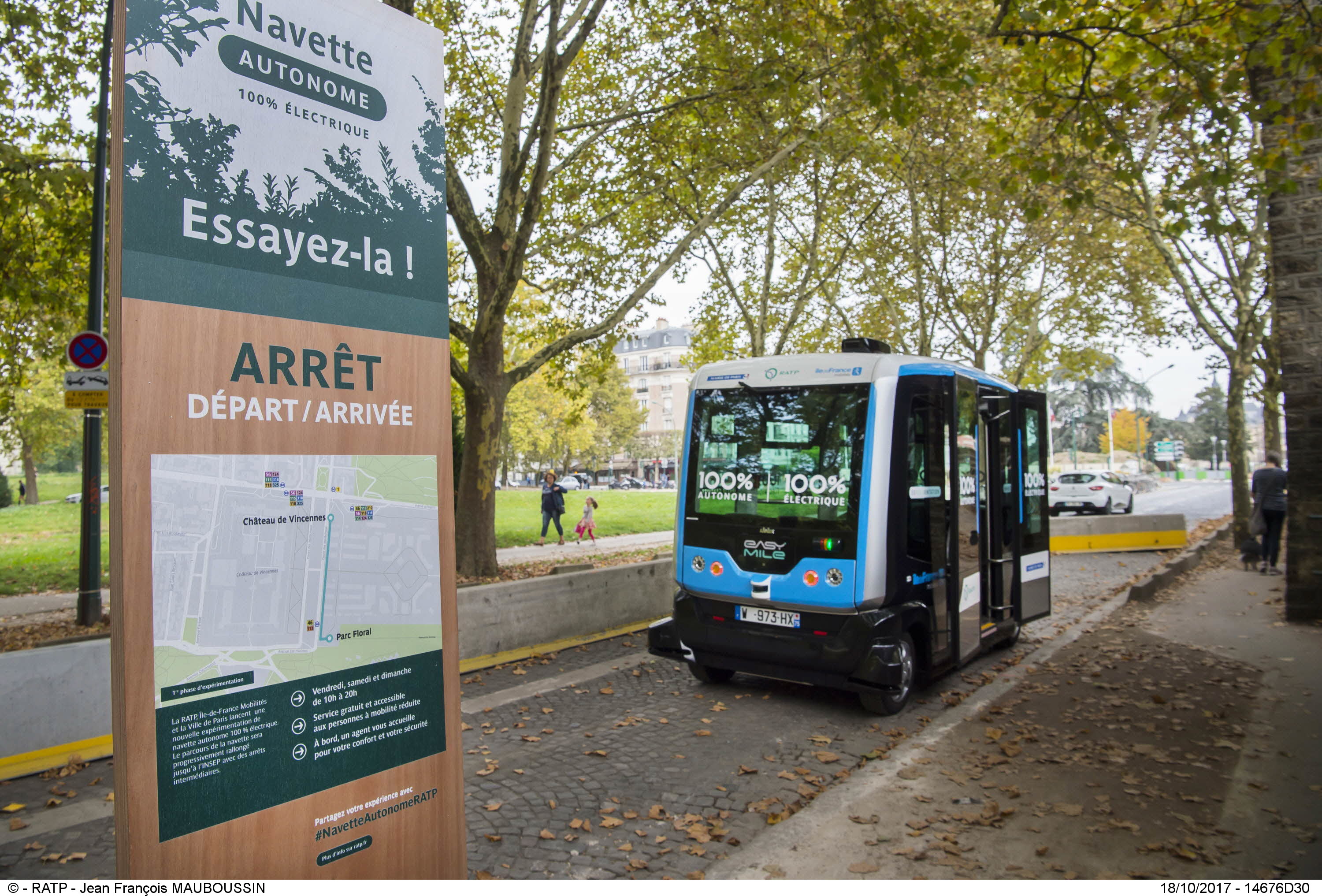
Marie-Claude Dupuis, Directrice de la stratégie, de l’innovation et du développement du groupe RATP, et Philippe Watteau, Directeur Général de l’Institut de Transition Energétique VEDECOM, annoncent la signature d’un accord de partenariat pour accélérer la recherche et l’innovation de la RATP dans le domaine des mobilités du futur.
Ce partenariat s’inscrit dans le cadre de la convention, signée en décembre dernier, actant l’adhésion de la RATP en tant que membre de VEDECOM. Les deux partenaires vont collaborer sur des projets de recherche, principalement dans les domaines des véhicules autonomes, des routes connectées et coopératives et des nouveaux services de mobilité.
Les premières réalisations s’inscriront dans le cadre du programme véhicules autonomes du groupe RATP qui vise à proposer de nouveaux services pour compléter l’offre de mobilité existante. Le groupe RATP a déjà mené 5 expérimentations en France et à l’international, avec près de 100 000 voyageurs transportés.
Vers des systèmes de transport public autonomes
La mise en œuvre de ces nouveaux systèmes de transport se déclinera autour de trois axes de recherche :
– Il s’agit tout d’abord de tester et d’optimiser l’intelligence de pilotage de ces nouveaux véhicules, entre les équipements embarqués et ceux qui seront placés dans les infrastructures, dans le cadre d’expérimentations en cours.
– Il s’agit ensuite de valider un système de supervision et de contrôle commande multiconstructeurs des flottes de véhicules autonomes. Pour ce faire, les partenaires mettront en commun leurs expertises. La RATP apportera son savoir-faire dans la sécurité et la sûreté de fonctionnement de réseaux de transport multimodaux. L’Institut VEDECOM apportera quant à lui l’expertise acquise dans le cadre de ses expérimentations de véhicules autonomes à la demande supervisés sur base Zoé et Twizy.
– Enfin, le Groupe RATP étendra cette collaboration à d’autres projets collaboratifs d’expérimentation de véhicules autonomes à grande échelle.
Le big data et l’intelligence artificielle au service de la sûreté de fonctionnement
Ce partenariat sera aussi l’occasion d’une réflexion sur l’utilisation des datas au service de la sûreté de fonctionnement de ces nouveaux véhicules, notamment dans l’identification des situations à risque. Cette réflexion combinera l’expertise de VEDECOM acquise dans le cadre du projet MOOVE et celle de la RATP sur ses lignes de métros automatiques.
Selon Marie-Claude Dupuis, Directrice de la stratégie, de l’innovation et du développement du groupe RATP : « Le véhicule autonome est un des domaines prioritaires en matière d’innovation pour le groupe RATP. Collaborer avec VEDECOM nous permettra d’accélérer le développement de nouveaux services de mobilités pour proposer une offre de transport globale, « porte-à-porte », connectée et durable ».
Philippe Watteau, Directeur Général de l’Institut de Transition Energétique VEDECOM a déclaré : « Intégrer le groupe RATP dans nos programmes de recherche signifie s’inscrire dans la dynamique d’innovation d’un groupe actif à l’international. Nous partageons avec le groupe RATP le souhait de créer un référentiel français pour la mise à la route de systèmes autonomes de transport de voyageurs ».
The page you requested could not be found. Try refining your search, or use the navigation above to locate the post.
Marie-Claude Dupuis, Director of Strategy, Innovation and Development at RATP Group, and Philippe Watteau, General Manager of the VEDECOM Institute for Energy Transition, announce the signing of a partnership agreement to accelerate RATP’s research and innovation in the field of future mobility.
This partnership is a result of the agreement signed last December certifying RATP’s membership in VEDECOM. Both partners will work together on research projects, primarily in the fields of autonomous vehicles, connected and cooperative roads and new mobility services.
The page you requested could not be found. Try refining your search, or use the navigation above to locate the post.
H2020 European project HEADSTART (Harmonised European Solutions for Testing Automated Road Transport) was launched in January 2019. It is deployed by a consortium of 21 partners, from 9 different countries, one of which is VEDECOM Institute, under the coordination of IDIADA and Mr Álvaro Arrúe. The consortium’s vision is to define testing and validation procedures of Connected and Automated Driving functions including key technologies such as communications, cyber-security and positioning. The tests will take place in simulation and real-world fields with the aim to validate safety and security performance according to the key users’ needs.
The HEADSTART project will bring together the consortium with other European and national CAD stakeholders to cluster the most relevant existing initiatives, develop methodologies, procedures and tools and drive in a harmonized European solution for testing and validation of automated road vehicles. Within the lifetime of the project, relevant stakeholders will be able to join the experts’ network so as to configure together the methodologies used and also promote the project results’ adoption.
Within the consortium, VEDECOM is responsible for the first work package (WP1) with the objective of establishing the state of the art on testing and validation methodologies, identifying the needs of stakeholders, defining the requirements for key technologies and selecting the most relevant use cases in various traffic scenarios to be tested on proving ground or simulation for Connected and Automated Vehicle (CAV) certification.
VEDECOM is also contributing to WP2 to define a methodology for CAD testing and validation for the targeted use cases, taking into consideration the key technologies.
This project has received funding from the European Union’s Horizon 2020 research and innovation programme under grant agreement No 824309.
The page you requested could not be found. Try refining your search, or use the navigation above to locate the post.
Le projet HEADSTART (Harmonised European Solutions for Testing Automated Road Transport), du programme Horizon 2020 de la Commission Européenne, a été lancé en janvier 2019. Porté par un consortium de 21 partenaires de 9 pays différents, dont l’Institut VEDECOM, il est coordonné par IDIADA Automotive Industry et Monsieur Álvaro Arrúe. Il a pour but de définir des procédures de test et de validation pour des fonctions de conduite automatisée et connectée en incluant les technologies clés telles que la cybersécurité, la localisation et la connectivité. Les tests auront lieu dans des environnements tant virtuels que réels afin de valider les performances de sûreté et sécurité relatifs aux principaux besoins des utilisateurs.
Lancé pour une durée de trois ans, le projet HEADSTART va rassembler des acteurs pertinents de la chaîne de valeur européenne des véhicules connectés et autonomes, autour du groupe d’experts du projet qui orientera et conseillera les partenaires et participera à la promotion des résultats du projet. Le consortium et ses partenaires réuniront les solutions existantes les plus pertinentes, développeront des méthodologies, des procédures et des outils, et piloteront une solution européenne harmonisée de test et de validation des véhicules automatisés.
Au sein du consortium, l’Institut VEDECOM est en charge du WP1 qui a pour objectif d’effectuer un état de l’art sur les méthodologies de tests, d’identifier les besoins des Stakeholders, de définir les exigences pour les technologies clés, et de sélectionner les cas d’usage pertinents à tester sur piste ou en simulation en vue d’une homologation des fonctions de conduite automatisée. L’Institut contribuera également au WP2, pour définir une méthodologie de test et validation pour les cas d’usages ciblés, en prenant en considération les technologies clés.
Le projet est financé par le programme de recherche et d’innovation Horizon 2020 de l’Union Européenne, sous l’agrément N°824309.
The page you requested could not be found. Try refining your search, or use the navigation above to locate the post.

The inauguration of the trinational digital test bed took place on Wednesday, April 3rd 2019, in Schengen (Luxembourg). On this occasion, VEDECOM presented the TRIICA project, whose main goal is to demonstrate the continuous compatibility for communicating vehicles with driving delegation between three countries in relationship with the infrastructures.
The event took place in the presence of the ministers of Transport of France, Germany and Luxembourg, as well as the Luxembourgish deputy prime minister and the minister of Transport of the Saarland. The creation of the site reflects the common will of the three countries to promote the development and experimentation of various technologies for automated and connected driving in a real-world and cross-border context.
Coordinated by VEDECOM, the TRIICA project is seeking its European partners
Philippe Watteau, CEO of the VEDECOM Institute, took the opportunity of the event to present the TRIICA project (Test and Research on Intelligent Infrastructure for Collaborative Autonomous driving) which was set up by VEDECOM in response to the Call for Expression of Interest published by the Ministries of the three countries in 2018. The project is coordinated by VEDECOM and carried by a consortium of 6 French partners (Cerema, Sanef, YoGoKo as well as the French subsidiaries of 3M and Continental). They aim to further extend the consortium to German and Luxembourgish partners.
TRIICA project’s main goal is to demonstrate the continuous compatibility for communicating vehicles with driving delegation between three countries while valorising the benefits of road infrastructures for the development of automated driving technologies.
Analysing and comparing risk situations for autonomous vehicles in cross-border regions
The first step will consist of detecting and analysing for each country different specific road signalling types, leveraging vehicles with perception capabilities that are representative of level 4 connected autonomous vehicles. This comparison will allow to identify risk situations generated by specificities of cross-border context. Horizontal and vertical innovative road signalling will be tested to assess their potential additional value for autonomous driving vehicle. Continuity of the connectivity management (roaming) in cross-border regions will also be considered. To conclude this first use case, specifications and recommendations will be issued to guide the development of vehicles with driving delegation and their infrastructures.
An enriched Local Dynamic Map (LMD)
The second step will aim to widen the AD vehicles’ perception by eHorizon which is a cloud service enriched by a local dynamic map (LDM) giving the opportunity to inform the vehicle of risk situations leading to a decrease of the current SAE level. The capacity of the vehicle to initiate a fall back safe-stop manoeuvre in an informed refuge zone will therefore be considered.
Designing a new autonomous vehicle prototype to demonstrate the pre-determined concepts
In a last step, a new prototype vehicle with driving delegation, designed by VEDECOM, will integrate specifications developed in previous use cases. This will allow to demonstrate the various driving situations considered in the first steps.
As the project coordinator of TRIICA, VEDECOM will be leading the different research and development activities as well as the experimentations and evaluation.
The page you requested could not be found. Try refining your search, or use the navigation above to locate the post.