No Results Found
The page you requested could not be found. Try refining your search, or use the navigation above to locate the post.


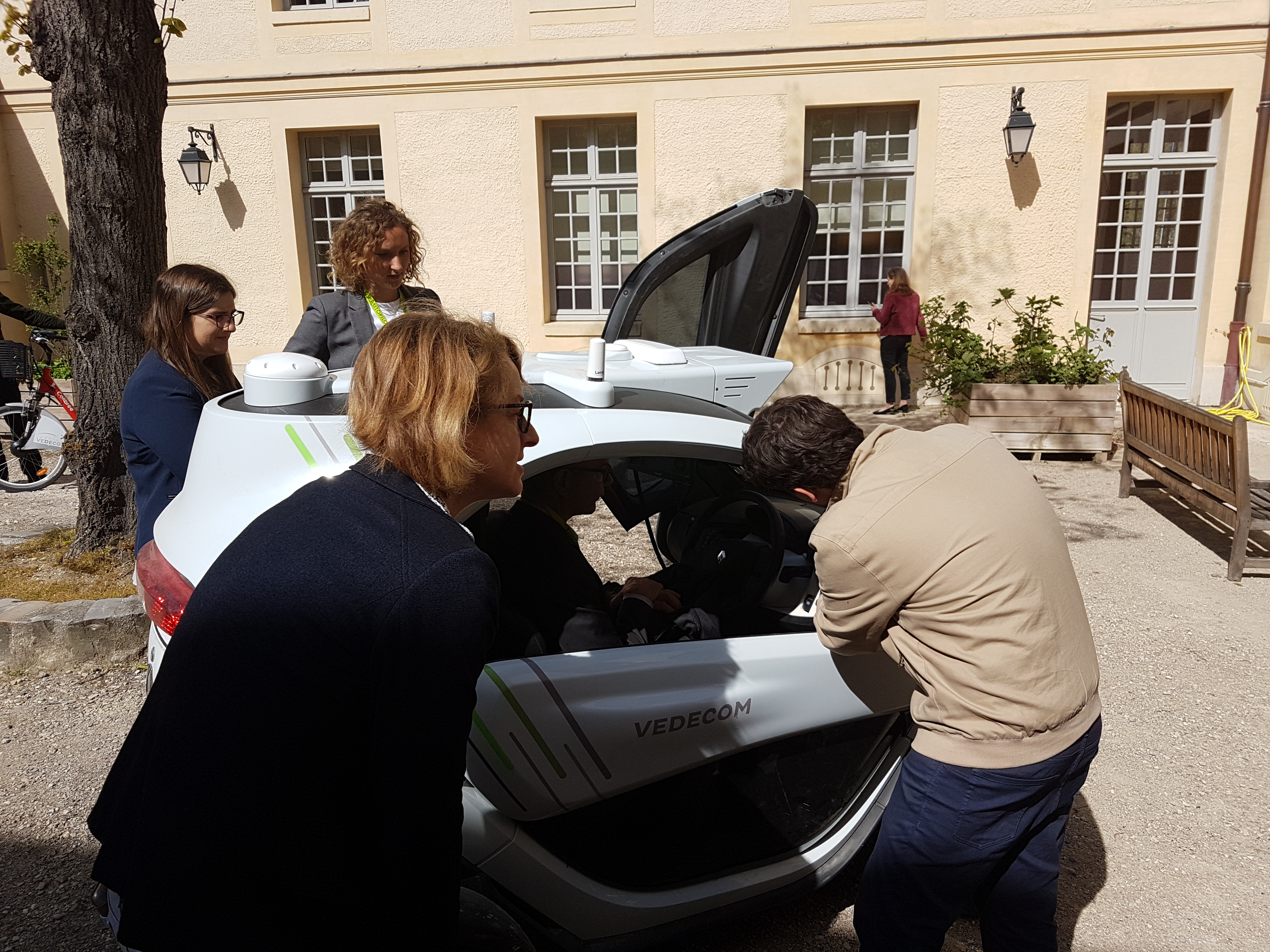
L’ouverture de la première Biennale d’Architecture et de Paysage, organisée par la région Ile-de-France du 4 mai au 13 juillet 2019, a été l’occasion pour l’Institut VEDECOM de présenter au public ses navettes autonomes. L’un des deux véhicules a été exposé du 4 au 6 mai devant les bâtiments de la Communauté d’Agglomération de Versailles Grand Parc. La démonstration statique a permis à l’équipe de VEDECOM Tech de présenter au public le service de navettes autonomes qui dessert l’allée des Marronniers jusqu’au mobiLAB.
Le service de navettes autonomes de l’Institut VEDECOM a été inauguré le 10 décembre 2018. Mis en œuvre par VEDECOM Tech et opéré par Transdev, ce service de navettes autonomes est le premier en France à naviguer sur route ouverte avec perception étendue.
The page you requested could not be found. Try refining your search, or use the navigation above to locate the post.


6 mai 2019
Dans le cadre du projet AUTOPILOT, un séminaire « Internet des objets et délégation de conduite » a eu lieu jeudi 18 avril dans les locaux de la Communauté d’Agglomération de Versailles Grand Parc. Il réunissait des parties prenantes des expérimentations menées sur le site pilote français à Versailles, dans le but de réfléchir à l’opportunité de déployer les services expérimentés ainsi que sur la construction de modèles économiques associés.
Evaluer la valeur ajoutée de l’Internet des Objets (IoT) pour la délégation de conduite
Le projet AUTOPILOT est un projet du programme Horizon 2020 de la Commission Européenne. Lancé en 2017, il a pour objectif d’évaluer la valeur ajoutée des technologies issues de l’internet des objets (IoT) pour la délégation de conduite. Des expérimentations en conditions réelles sont menées sur 6 sites pilotes en Europe et en Asie, dont la ville de Versailles. L’Institut VEDECOM assure la coordination globale des sites pilotes et de leurs expérimentations de véhicule autonome, ainsi que la mise en œuvre des cas d’usages déployés à Versailles. Dans ce cadre, VEDECOM a développé 3 VFLEX électriques, connectés et autonomes (base Renault Twizy).
Deux cas d’usages expérimentés sur le site versaillais : conduite urbaine couplée à un service d’autopartage et platooning
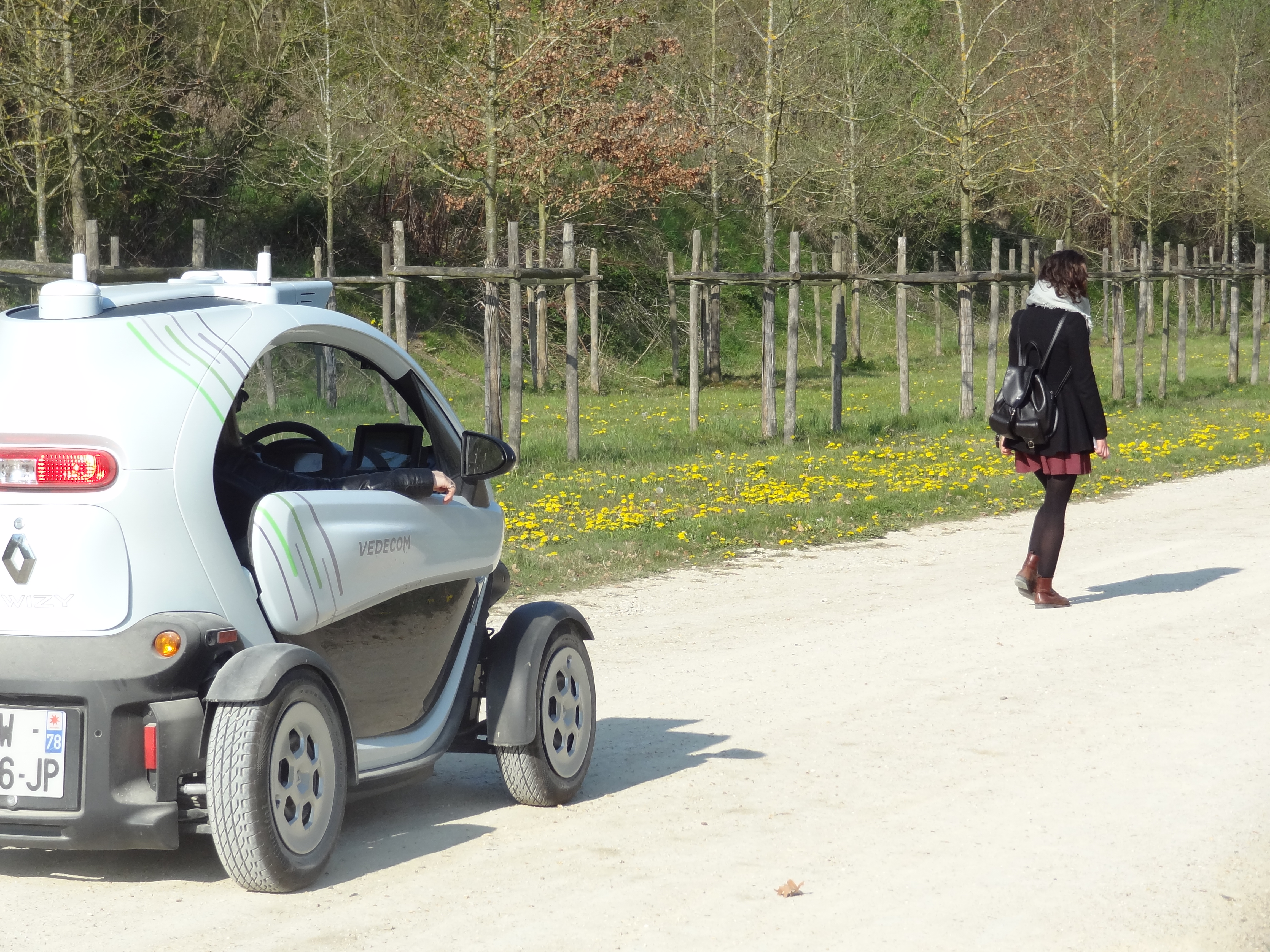
Deux cas d’usage sont expérimentés sur le site versaillais. Un ‘parcours utilisateur’ est destiné aux touristes souhaitant découvrir les points d’intérêt de la ville de Versailles en conduite connectée et autonome. Il rencontre des usagers vulnérables de la route (piétons et cyclistes) équipés d’objets connectés qui informent le véhicule de leur présence. Cela lui permet d’adapter sa vitesse en conséquence. Les expérimentations ont été menées fin avril 2019. Le ‘parcours opérateur’ quant à lui met en œuvre un service de platooning (convoi) qui permet le rééquilibrage automatique de la flotte de véhicules entre les deux stations d’autopartage installées sur le territoire dans le cadre du projet. Les expérimentations auront lieu début juillet 2019.
Le parcours utilisateur : sécuriser la conduite par la redondance d’informations des capteurs du véhicules et des IoT
Arrivé à la Pièce d’Eau des Suisses, l’utilisateur est invité à passer en conduite déléguée. Sur son passage, il rencontre des usagers vulnérables de la route équipés d’objets connectés (smartphones, smartwatch, vélo connecté). L’objet de l’expérimentation est alors de faire la preuve de la valeur ajoutée de ces objets pour la conduite déléguée : la redondance des informations enregistrées par les capteurs du véhicule et les objets connectés va permettre de sécuriser davantage la conduite. La démonstration est convaincante : le véhicule se trouve soudainement confronté à l’irruption d’un cycliste non équipé d’IoT qui lui barre la route à pleine vitesse. Le freinage d’urgence est activé, le véhicule pile. Même scénario mais cette fois-ci avec un vélo connecté à l’IoT : le véhicule commence à ralentir bien avant l’intersection incriminée. Les informations envoyées par le vélo ont permis au véhicule d’anticiper la présence, la vitesse et l’intention du cycliste, et d’adapter sa conduite en conséquence.
Le parcours opérateur : rééquilibrer automatiquement la flotte automobile grâce au platooning
Le deuxième cas d’usage consiste en un parcours opérateur, visant à faciliter le rééquilibrage de la flotte de véhicules en autopartage. Les expérimentations concernent alors le platooning ou convoi. Un service de Fleet Management System identifie sur la tablette de l’opérateur quand et de combien il va falloir rééquilibrer la flotte automobile entre les deux stations d’autopartage équipées de bornes de recharge installées dans la ville. L’agent peut alors réaliser un petit convoi de véhicules autonomes, capables de suivre automatiquement la trajectoire d’un véhicule de tête, qu’il conduit manuellement. L’échange de données se fait entre les véhicules, mais aussi entre les véhicules et l’infrastructure. Des unités de bord de route permettent ainsi au véhicule de tête de communiquer avec les feux afin de permettre la traversée des intersections en toute sécurité et sans coupure du convoi (Traffic Light Assist).
Un workshop pour évaluer l’opportunité de déploiement des services et les modèles économiques associés
Dans le cadre des phases 4 et 5 du projet AUTOPILOT, l’Institut VEDECOM, la Communauté d’Agglomération Versailles Grand Parc et leurs partenaires ont invité ce jeudi 18 avril l’ensemble des parties prenantes à un séminaire : « Internet des objets et délégation de conduite ». Le workshop avait pour but d’évaluer les opportunités et les freins au déploiement des services mis en œuvre dans les expérimentations et de réfléchir à un business model pérenne qui pourrait les porter. La journée a alterné présentations du projet et des partenaires, démonstrations et temps de discussion interactifs afin de permettre aux participants de cerner au mieux les services proposés et d’envisager les meilleurs modèles économiques associés.
The page you requested could not be found. Try refining your search, or use the navigation above to locate the post.
10 mai 2019
As part of the AUTOPILOT project, a seminary entitled ‘The Internet of Things and Delegated Driving Technology’ was held on Thursday, 18th April at the Communauté d’Agglomération de Versailles Grand Parc. It brought together stakeholders in experiments conducted on the French pilot site in Versailles. The objective was to consider the opportunity to roll out the services being tested as well as construction of associated economic models.
Assessing the value added by the Internet of Things (IoT) to delegated driving
The AUTOPILOT project is a European Commission Horizon 2020 programme project. Launched in 2017, the project aims to assess the added value of technologies stemming from the Internet of Things (IoT) for driving assistance. Real-life experiments are being conducted at 6 pilot sites in Europe and Asia, including in the city of Versailles. VEDECOM Institute is ensuring the overall coordination of pilot sites and their autonomous vehicle experiments. It is also overseeing the implementation of use cases rolled out in Versailles. In that framework, VEDECOM has developed 3 electric, connected, and autonomous VFLEX vehicles (based on the Renault Twizy).
Two use cases examined at the Versailles site: urban driving combined with a car sharing and platooning service
Two use cases are being tested at the Versailles site. There is a ‘user mode’ for tourists who want to discover points of interest in the city of Versailles using connected and autonomous driving technology. It identifies vulnerable road users (such as pedestrians and cyclists) with connected objects that inform the vehicle of their presence. That helps the vehicle adjust its speed accordingly. These experiments were conducted in late April 2019. As for the other option, the ‘operator mode’, it employs platooning technology to send convoys of cars between two car sharing stations installed in the area as part of the project. This mode is used for automatic rebalancing of the number of cars at the stations. The experiments will take place in early July 2019.
The user mode: making driving safer through redundant information from vehicle sensors and the IoT
The experiment scenario for the user mode involves tourists who want to visit the city of Versailles. After reserving a connected, autonomous car sharing vehicle, the user starts a route through the city using manual and connected driving. Along their route, they receive tourist notifications via a connected tablet inside the vehicle and 14 BLE tags installed around the city by tourist points of interest (PoI).
Once the tourist arrives at the Pièce d’Eau des Suisses, they are invited to switch to the delegated driving mode. Along their way, they will encounter vulnerable road users with connected objects (such as smartphones, smartwatches, and connected bicycles). The objective of this experiment is to show the value provided by these objects in driving delegation technologies. Namely, the redundancy of information provided by connected objects and vehicle sensors will help make driving even safer. The demonstration is quite convincing. One example is when a vehicle going full speed is suddenly confronted with a cyclist without a connected object who is blocking their route. This activates emergency breaking and the vehicle comes to a sudden stop. Now imagine the same scenario when the bike has a connected object. This time, the vehicle starts to slow down long before it reaches the intersection where it will encounter the bike. The information sent by the bicycle have helped the car anticipate the presence, speed, and intentions of the cyclist and adapt its driving accordingly.
The operator mode: automatically rebalancing the number of cars at a station through platooning
The second use case involves the operator mode. This mode aims to facilitate the rebalancing of cars being shared. The experiments examine platooning or creating convoys of vehicles. A Fleet Management System identifies when and how to rebalance the number of cars at two car sharing stations in the city equipped with charging stations. This information is relayed on the operator’s tablet. The operator can then create a little convoy of autonomous vehicles that can automatically follow the trajectory of a lead vehicle that the operator drives manually. Data is exchanged from one car to another, but also between the vehicles and the infrastructure. Roadside units help the lead vehicle communicate with traffic lights to allow the entire convoy to cross intersections safely without being broken part (a feature called Traffic Light Assist).
A workshop to assess the opportunity for rolling out services and associated economic models
As part of phases 4 and 5 of the AUTOPILOT project, the VEDECOM Institute, the Communauté d’Agglomération Versailles Grand Parc, and their partners invited all stakeholders to a seminar on Thursday, 18th April. The seminar was entitled ‘The Internet of Things and Delegated Driving Technology’. The aim of the workshop was to assess the opportunities and obstacles to rolling out services used in the experiments and to reflect on a lasting business model to accompany these services. The day alternated between project and partner presentations, demonstrations, and interactive discussion times to allow participants to gain a clear understanding of the services in question and to reflect on the best economic models to go with them.
The page you requested could not be found. Try refining your search, or use the navigation above to locate the post.
42 millions d’euros pour 16 expérimentations des véhicules autonomes

Rémy Le Boennec, Researcher at VEDECOM Institute and LGI CentraleSupélec (Université of Paris-Saclay), in collaboration with Isabelle Nicolaï (LGI CentraleSupélec, Université Paris-Saclay) and Pascal Da Costa (LGI CentraleSupélec, Université Paris-Saclay), has set out a study within a research project dubbed the Institut VEDECOM New Mobility Offers Observatory [Observatoire des Nouvelles Solutions de Mobilité de l’Institut VEDECOM]. It is assessing fifty emerging mobility offers on the basis of sustainable development indicators and local characteristics. The aim is to help decision makers to construct their own relevant and viable scenarios for instigating new mobility initiatives in their territories. Here we feedback on the study that featured at the international Transport Research Arena (TRA2018) conference which took place from 16-19 April in Vienna.
Moving toward new uses for private cars and modes of transport
The traditional “either/or” view of private cars vs. public transport is waning and many now see the automobile as “public transport of tomorrow” that will supplement local government schemes in places and at times that are currently not competitive (sparsely populated areas, evenings, etc.). Heralded for their convenience, 64% of rural French people and 44% of those living in conurbations of more than 100,000 inhabitants use cars daily.[1] However, they bring with them their share of disadvantages (noise, pollution, greenhouse gas emissions), accidents and traffic jams. At the same time, the advent of inclusive transport concepts, which aim to provide tangible and affordable solutions to categories of the population that do not have access to “standard” forms of mobility, encourages a rethinking of getting from A to B and improvements to the institutional framework that encompasses this. Actually adopting new sustainable mobility offers requires overcoming both psychological and sociological obstacles. Despite encouraging signs of development, users who regularly go inter-modal, i.e. combine several modes of transport on the same journey, or multi-modal, meaning that they alternate between several transport modes on different journeys, still represent a very small percentage of the overall population.
The New Mobility Offers Observatory – a decision-making tool
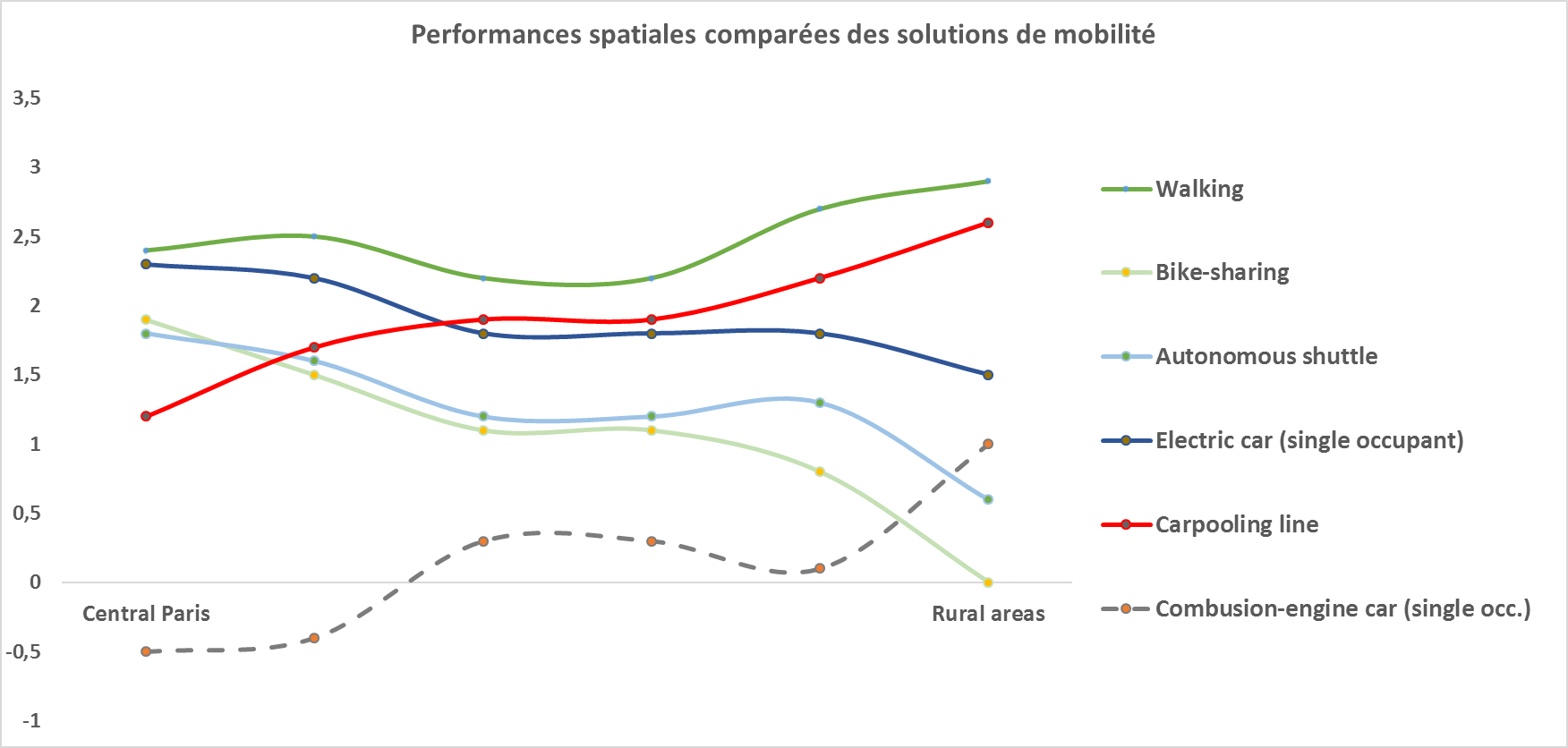
This study, which was presented at the TRA2018 conference, was carried out to reduce both social and geographical costs. It also supports changes in behaviour and takes into account the profusion of new mobility offers in the decision-making process. The Observatory aims to assess new mobility offers for decision-makers, looking at the relevant socio-demographic and geographical characteristics of each type of area in terms of their specific population and employment density and population flows. For any given journey, each solution assessed has been compared to a private combustion-engine car used by a single driver. The particularities of each area are crucial. For example, though car-sharing solutions have proved suitable for city centres, they rarely are in less-densely populated areas. Likewise, Uber’s success is linked to the short distances to cover in city centres. The question is, how do we identify the characteristics of inter- and multi-modal users to transfer them to people who use cars exclusively, thus helping transport operators, both long-standing and new to the market, to design new offers that are appropriate for the target market and economically sustainable.
A specific solution for each area, including inside the Ile-de-France Region in France
The assessment carried out within the New Mobility Offers Observatory project will go hand in hand with establishing territorial profiling. For example, for the Ile-de-France Region in France, different types of areas have been identified, from central Paris to periurban and rural areas. The particularities of each type of area in terms of travel require the use of different mobility offers. In central Paris, long-standing (public transport) and emerging offers (shared bikes, kick-scooters and electric scooters) coexist, making it difficult to manage transport policies that best navigate the different solutions. In close suburbs, the use of bike- and car-sharing is often on top of long-standing public transport methods. In the rest of the Paris conurbation, public transport networks are still dense, but given the large distances covered, it is difficult to offer uninterrupted mobility services: for example, when you pick up a shared bike from one station you need to have the possibility of dropping it off in a more remote place. In the medium-sized towns in the rest of the Ile-de-France region (in periurban areas), mobility services are usually organised around the train stations. Lastly, in other municipalities of the Ile-de-France Region (and farther) that do not have a train station, outside of isolated experiments, we have seen a real lack of mobility offers that offer an alternative to private cars in those less densely populated areas.
An innovative, two-step method for developing specific transport scenarios for each region
To try to offer solutions to these various problems, the New Mobility Offers Observatory is assessing fifty mobility offers, most of them emerging ones. It uses an innovative, two-step method. The first involves attributing a consolidated score, based on 18 indicators, to each of the offers after a Multi-Criteria Decision Analysis (MCDA). The chosen indicators have been elaborated into assessment process measurement indicators and approved by a group of transport experts, including researchers, manufacturers and local authorities. The selected criteria cover the three fields of sustainable development: economic, environmental and social.
After being put through Diviz software, the results show that in very densely populated areas, such as central Paris, private combustion-engine cars are not very efficient (due to more environmental criteria in central areas), unlike less densely populated regions, where private car use is widespread, primarily out of habit and for practical reasons (saving time, etc.). For similar reasons, carpooling emerges as an environmentally friendly alternative in less-densely populated areas. Conversely, a private electrical car’s efficiency diminishes the further you travel from densely populated areas. The use of active-travel sharing solutions (e.g. Velib shared bikes in Paris) is only usually viable and practical in city centres. Driverless shuttles appear to work along the same lines, both because the speed of travel makes them less competitive than combustion engine cars in less densely populated areas, but also because environmental concerns are less widely felt (environmental criteria less weighted in less densely populated areas). Surprisingly, walking earned the highest score, regardless of the type of area under consideration, as much for economic (low cost to the user) as environmental or even social reasons (practised almost universally, trust in the method, etc.).
In the second stage, software called MICMAC is used to map influence and dependence between the 18 indicators. For each type of area, it compiles a matrix of the interactions between the different criteria, taken two by two. The final result is a criteria influence and dependence map that can be used to develop one or two territorial scenarios for designing innovative or hybrid mobility offer.
Three things to bear in mind when promoting more sustainable mobility
Many observation bodies are looking at the mobility of the future. The originality of the New Mobility Offers Observatory resides in the fact that it compares emerging offers such as carpooling, car-sharing and active modes, using scores obtained from MCDA. It is unique in that it offers public authorities additional elements in order to make more precise decisions about the solutions to take forward. Thanks to systematic monitoring, the Observatory will continue to assess and rank new mobility offers. After the mid-point results, three elements have emerged in favour of more sustainable mobility:
A small part of a more global array of options to support transport decision makers
Going forward, The New Mobility Offers Observatory will be an integral part of a more global array of options for businesses and local government:
Read the full article
Contact the author => mailto :remy.leboennec@vedecom.fr
https://www.researchgate.net/profile/Remy_Le_Boennec
[1] Source: Chronos, ObSoCo, 2018
The page you requested could not be found. Try refining your search, or use the navigation above to locate the post.