No Results Found
The page you requested could not be found. Try refining your search, or use the navigation above to locate the post.
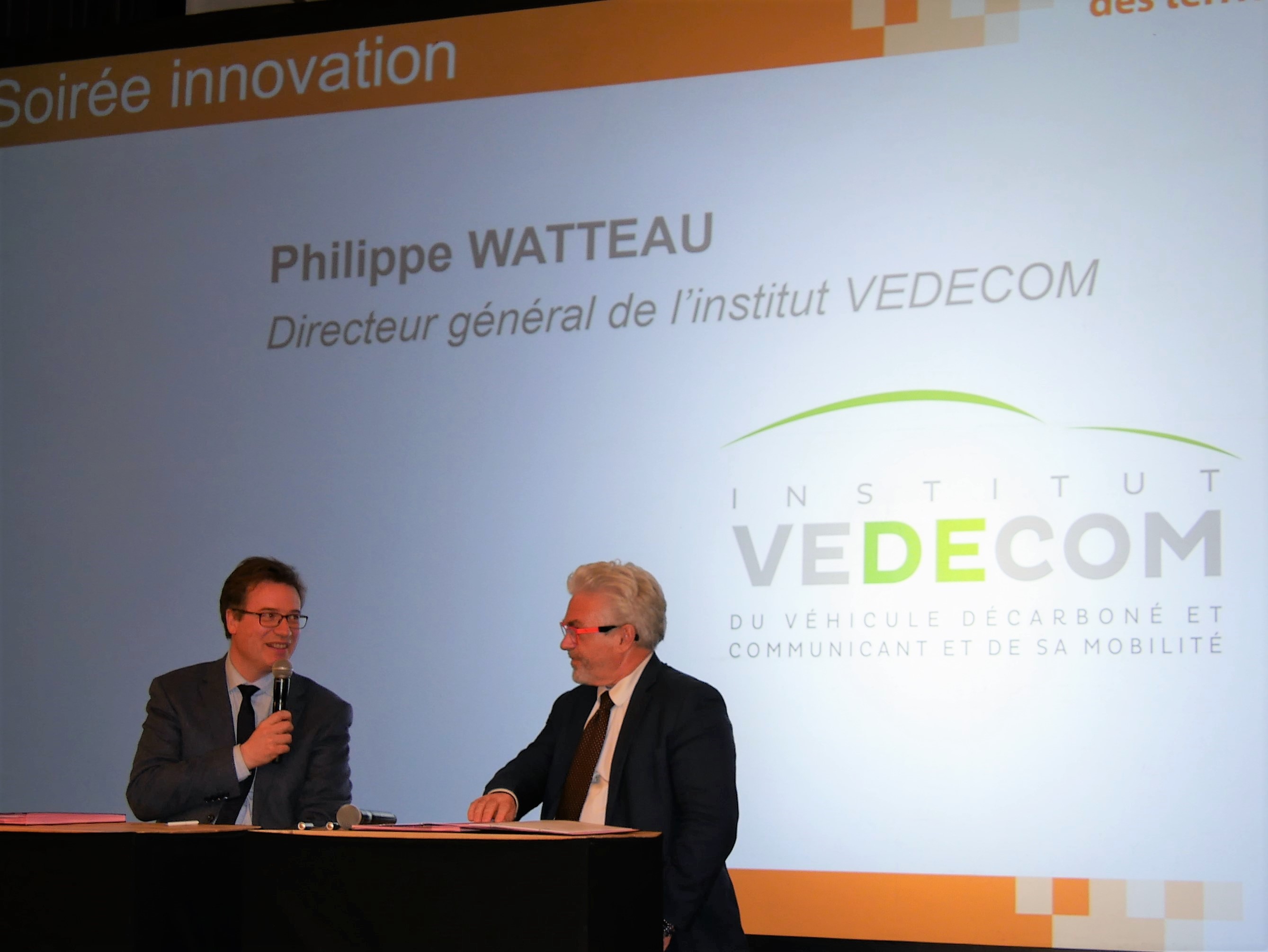
Today, at the ‘Biennale des territoires’ in Montrouge, Pascal Berteaud, CEO of the Cerema and Philippe Watteau, CEO of VEDECOM, signed an agreement acknowledging the Cerema’s integration as a member of VEDECOM, with the aim of developing large-scale initiatives in their respective areas of excellence.
The Cerema and VEDECOM have thus formalised their willingness to establish a long-term partnership in the field of electric, connected and autonomous vehicles and cooperative roads.
The goal is to contribute to the societal and technological qualification of electric, connected and autonomous vehicles, and also promote their deployment and use. Through this cooperation, the partners will develop new areas of shared interest as well as ambitious innovative projects. According to Philippe Watteau, “this partnership will enable us to complete our systemic vision of new mobilities, which includes vehicles, cooperative infrastructures and road network managers at the local level”. “These new mobilities will permanently shape the development of territories, which will require support by local authorities and an assessment of the medium- and long-term impacts” added Pascal Berteaud.
This partnership also ensures the continuity of the autonomous vehicle training programmes given jointly over the last 2 years by the Cerema and VEDECOM.
VEDECOM is an institute for energy transition (ITE) founded on unique cooperation between firms in the automotive and aviation sectors, mobility ecosystem infrastructure and service operators, academic research bodies and Ile-de-France local authorities. The role of VEDECOM is to forge closer ties between academia and industry. The institute helps them to achieve a high standard of innovation in the area of mobility and, in particular, in electric vehicles, autonomous and connected vehicles and shared energy and mobility infrastructure and services. VEDECOM is a part of the French government’s PIA future investment plan. Its founding members are Cetim, ESIGELEC, ESTACA, IFPEN, IFSTTAR, PSA Group, Renault Group, Safran, UVSQ and Valeo.
The Cerema is a French public establishment of an administrative nature created in 2014 on risks, environment, mobility and urban planning. In terms of mobility, in particular, it contributes to work on standardisation, testing of autonomous vehicles, qualification of road equipment and deployment of cooperative transport systems.
The page you requested could not be found. Try refining your search, or use the navigation above to locate the post.
Pascal Berteaud, Directeur général du Cerema, et Philippe Watteau, Directeur général de VEDECOM, ont signé le 19 mars 2019 un accord de partenariat lors de la Biennale des territoires à Montrouge.
Le Cerema est un établissement public à caractère administratif créé en 2014 sur les risques, l’environnement, la mobilité et l’aménagement. En termes de mobilité, il participe notamment à des travaux sur la normalisation, l’expérimentation des véhicules autonomes, la qualification des équipements routiers et le déploiement de systèmes de transport coopératifs.
L’intégration du Cerema parmi les membres de VEDECOM formalise la volonté des deux parties de coopérer sur le long terme dans le domaine des véhicules électriques, connectés et autonomes ainsi que dans celui des routes coopératives.
« Ce partenariat nous permet de compléter notre vision systémique des nouvelles mobilités, qui englobe les véhicules, les infrastructures coopératives et les gestionnaires routiers à l’échelon local », a déclaré Philippe Watteau. Et Pascal Berteaud de compléter : « Ces nouvelles mobilités façonneront durablement le développement des territoires, ce qui nécessitera un accompagnement des collectivités et une évaluation des impacts sur le moyen et le long terme. »
Ce partenariat s’inscrit dans la continuité des programmes de formation sur le véhicule autonome dispensés conjointement par le Cerema et VEDECOM depuis 2 ans.
The page you requested could not be found. Try refining your search, or use the navigation above to locate the post.
Is this the end of accidents, gridlock, and pollution ? Many are those who consider the arrival of autonomous vehicles on our roads as key to responding to current mobility challenges. But thus far, the technological questions have overshadowed the essential debates and any reasoned approach has been clouded by the fantasies generated by autonomous vehicles.
In an effort to get to the bottom of this burning issue, Jean-Pierre Orfeuil and Yann Leriche, two of the most prominent experts in the field, are releasing their book “Piloting the Autonomous Vehicle – Serving the City” this Thursday, March 7, 2019, from Descartes & Cie’s Mobile Cultures Collection.
According to them, autonomous vehicles, whatever their disruptive potential, will not be designing a new world on an blank sheet of paper. After providing an overview of our current understanding of the subject and delving into each development hypothesis, the authors review the concrete conditions we will set for the arrival of autonomous vehicles in our cities and lives. They have developped a unique analysis tool : TRUST. They thus invite us to move forward to prevent the promised autonomous vehicle running off course, but allow it to develop towards the collective good.
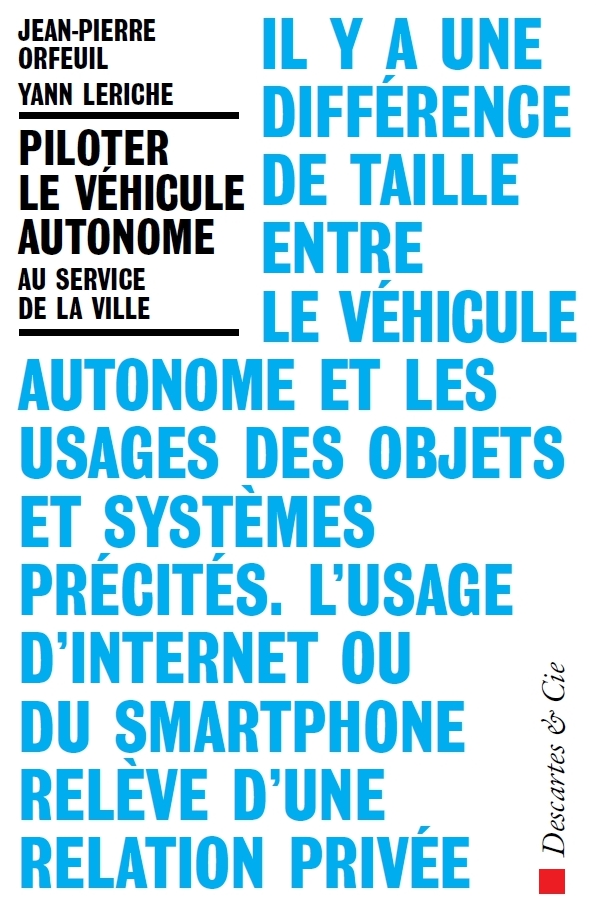
Book cover translation : “There is an important difference between the autonomous vehicle and the use of the aforementioned objects and systems. The use of the internet or a smartphone falls within a private relationship.”
The page you requested could not be found. Try refining your search, or use the navigation above to locate the post.
Finis les accidents, les embouteillages, la pollution ? Nombreux sont ceux qui considèrent l’arrivée des véhicules autonomes sur nos routes comme la clef pour répondre aux enjeux actuels de la mobilité. Mais jusqu’ici, les questions technologiques ont surplombé les débats essentiels. Toute approche raisonnée a été brouillée par les fantasmes suscités par l’intelligence artificielle, par la panique de l’industrie (il arrive, il faut en être…), par la croyance que le gagnant raflera toute la mise, par l’incroyable capacité de storytelling des géants de la Silicon Valley.
Le véhicule autonome, quel que soit son potentiel disruptif, ne dessinera pas un nouveau monde comme sur une feuille blanche.
Afin de faire toute la lumière sur ce sujet brûlant, Jean-Pierre Orfeuil et Yann Leriche, deux des meilleurs spécialistes de la question, publient ce jeudi 7 mars 2019 le livre « Piloter le véhicule autonome – au service de la ville » aux éditions Descartes & Cie, collection Cultures Mobiles.
Après avoir fait le point des connaissances actuelles, discuté chaque hypothèse de développement, les auteurs passent en revue les conditions concrètes que nous fixerons pour l’arrivée du véhicule autonome dans nos villes et dans nos vies, et développent un outil d’analyse inédit : « TRUST », dont l’objectif est de mieux cerner les interactions des phénomènes complexes, et éviter le piège des analyses partielles et donc partiales. TRUST permet de décliner la question centrale de la confiance en cinq grands domaines : Technologie, Règles, Usages, Système et services, et Territoires. En conduisant leur réflexion suivant cette méthodologie originale, de la technologie aux territoires, Jean-Pierre Orfeuil et Yann Leriche nous invitent à avancer pour que la révolution annoncée du véhicule autonome ne soit pas une sortie de route et qu’elle fasse progresser vers plus de bien-être collectif.
The page you requested could not be found. Try refining your search, or use the navigation above to locate the post.