VEDECOM meets with local authorities at the Salon des Maires

VEDECOM meets with local authorities at the Salon des Maires
This year once again, VEDECOM and VEDECOM Tech have enjoyed an opportunity to meet with local authority representatives at the Salon des Maires exhibition. The yearly national event for public procurement stakeholders was held on 19-21 November 2019 at the Porte de Versailles exhibition centre in Paris. An ideal opportunity for the Institute to present four innovative solutions to assist local authorities in their deployment of new mobility solutions: Marque ta Route (Mark your Road) and VEDETECT, alongside M’OBS and the interoperable supervisor for autonomous vehicles with enhanced perception.

An exhibition stand delving deep into the key issues facing local authorities

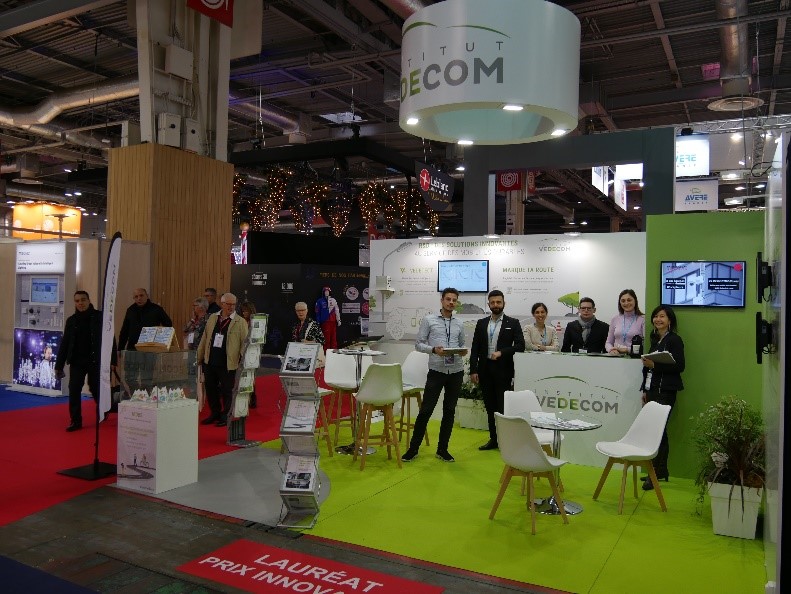
Located within the Transport and Vehicles zone, the Institute hosted an impressive stand at the Salon des Maires et des Collectivités Locales. Equipped with two didactic wall panels featuring both graphic artwork and screens, it gave a complete visual overview of the innovative mobility solutions presented by VEDECOM. Origami fortune tellers were hung from the stand, bearing the message: “when choosing mobility solutions for your local area, don’t leave your decision to chance”.

A somewhat unusual approach which was hugely successful! In the run-up to elections, the exhibition was a well-timed opportunity for VEDECOM to gauge the issues facing different local authorities, in all their diversity.

Marque ta Route and VEDETECT: two of VEDECOM’s award-winning innovations at the Grand Prix de l’Innovation

Among the four innovative solutions presented by the Institute, two were recognised by the Grand Prix de l’Innovation of the Salon des Maires on 22 October and were on show to the general public for the first time.

The “Marque ta Route” software, winner of the First Prize for Innovation in the Buildings/Public Works/Highways category, is a road assets management tool based on the PhD research thesis of Maxime Redondin. It provides a set of tools for reliability analysis and assistance with the replacement of road signage, using retroreflection data to automatically analyse road marking inspections.

The VEDETECT sensor network, created by Julian Garbiso, finalist in the NITC/Information Systems category, is a real-time system for measuring and analysing mobility. It uses artificial intelligence and the Internet of Things (IoT) to produce mobility measurements (flow, speed and start/end trajectories) that are comparable to results derived from more conventional methods at significantly lower cost. This solution, which will be expanded for use in estimating the density of pedestrians and passengers, will enable local authorities to better regulate traffic, and help them in formulating their transport policy.

Two VEDECOM Tech products: M’OBS and the interoperable supervisor for autonomous vehicles with enhanced perception

VEDECOM Tech also presented two new products. The M’OBS solution by VEDECOM Tech is an evaluation agency for new mobility solutions. It helps local authorities and mobility stakeholders to better understand their environment, to assess the suitability of new mobility solutions and to deliver the best possible user experience.

The commercial division of the VEDECOM Institute also showed a preview of its interoperable supervisor for autonomous vehicles with enhanced perception. Using an interface designed specifically for autonomous vehicles, the Supervisor provides access to a network of sensors installed on roadside infrastructures or in-vehicle systems. It also manages all communications between the different systems. In more concrete terms, it provides local authorities with an affordable and accessible learning and reporting tool to assist with implementing autonomous vehicle trials. It also provides assistance to transport operators and can incorporate new projects being developed by collective autonomous vehicle manufacturers.

Articles récents :
Retour sur la conférence VEDECOM « Intelligence Artificielle dans le domaine du véhicule autonome » du 28 septembre 2016

Retour sur la conférence VEDECOM « Intelligence Artificielle dans le domaine du véhicule autonome » du 28 septembre 2016

VEDECOM, l'Université de Versailles Saint Quentin en Yvelines (UVSQ) et l'Université de Cergy Pontoise (UCP), ont organisé conjointement une première journée scientifique sur le thème "Intelligence Artificielle et Véhicule à Conduite Déléguée". La journée avait pour...
read more

SMIV: now in its fourth year and set for longevity

SMIV: now in its fourth year and set for longevity

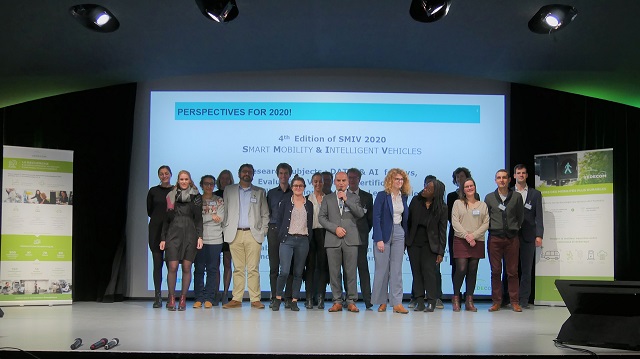
The VEDECOM Institute’s annual scientific conference on Smart Mobility and Intelligent Vehicle (SMIV) took place on 12 November. This year’s main theme was electromobility and collaboration between onboard (in-vehicle) and offboard (infrastructure) with a multidisciplinary approach starting from usage in order to focus on human-centric technology. The event was held at the Espace Saint-Martin in the heart of Paris: a more central and accessible venue for a conference with an international flavour.

SMIV: young and international in its fourth year

Longevity… surely is the term that springs to mind for this fourth SMIV meet. Focussed on particularly relevant issues, this year’s edition sealed the longer-term future of the event.

Located in Paris’s 3rd arrondissement, the conference brought together VEDECOM’s entire ecosystem, from industrial players to academics, based around issues related to the business model of electromobility and collaboration between the vehicle and its environment.

Result: 250 attendees, compared with 180 the previous year. A young, very international audience for a fully English-speaking conference. And diversity in terms of participants also, with many of the Institute’s international partners having accepted to participate alongside VEDECOM’s researchers. We hosted representatives from Switzerland (Dirk Lauinger), Germany (Dr Uta Burghard) and the Netherlands (Rick Wolbertus). VEDECOM was also delighted to welcome as a keynote speaker Professor Ramteen Sioshansi from the Ohio State University, introducing the first session of scientific presentations on economic challenges in electromobility. Renowned French research bodies such as INRIA and CEA were also represented, with Dr Fawzi Nashashibi, Programme Director at RITS (INRIA), introducing the second session and Dr Raphael David (CEA) speaking about the design of onboard systems for the vehicles of tomorrow.

Two sessions to reflect on the scientific and technical challenges of sustainable mobility

The day was divided into two parts, providing an opportunity to present the latest research findings on sustainable mobility, the scientific and technical challenges ahead and the economic and political issues involved.

The first session, entitled “Sustainable and Electric Mobility”, considered the challenges and issues of electromobility.

This covered issues including the charging infrastructure or market acceptance of new solutions to increase the range of electric vehicles.

The second session, “The intelligent vehicle and its collaboration with the infrastructure”, focussed more on communication and connectivity between the autonomous vehicle and its environment: connected infrastructures, man-machine interfaces (MMI), enhanced perception, etc.

“In your view, what is SMIV?” 

At the close of a day rich in both scientific and technical material, Féthi Ben Ouezdou, Scientific Director of the Institute, summed up SMIV in three short phrases: “Scientific excellence, strategic partnership for VEDECOM, sharing of outstanding research topics”. By way of conclusion, let’s simply quote a few of our participants.

SMIV is a very worthwhile conference in terms of scientific contributions, but also for networking, as it provides a forum for meeting with researchers in all fields and key industry players. It’s highly beneficial for the autonomous vehicle domain.” Dr Fawzi Nashashibi

“VEDECOM really does provide a unique opportunity with its SMIV conference. We can discuss not just scientific methods, but also market conditions, and debate on all the outstanding issues yet to be resolved.” Icaro Freitas-Gomes (VEDECOM doctoral student)

“It’s a great opportunity to see how people from different countries are working on electric and autonomous vehicles.” Dr Rick Wolbertus (Amsterdam University of Applied Sciences, TU Delft)

“We are delighted to have had such high attendance with over 250 people participating. Please join us again next year when we’ll be covering R&D topics related to the use of data and AI for the assessment, validation and certification of autonomous vehicles, as well as new mobility solutions within a societal and legal framework. We plan to run two sessions based on performance validation and the impact of new mobility solutions for organising urban spaces”, concludes Féthi Ben Ouezdou.

Articles récents :
Retour sur la conférence VEDECOM « Intelligence Artificielle dans le domaine du véhicule autonome » du 28 septembre 2016

Retour sur la conférence VEDECOM « Intelligence Artificielle dans le domaine du véhicule autonome » du 28 septembre 2016

VEDECOM, l'Université de Versailles Saint Quentin en Yvelines (UVSQ) et l'Université de Cergy Pontoise (UCP), ont organisé conjointement une première journée scientifique sur le thème "Intelligence Artificielle et Véhicule à Conduite Déléguée". La journée avait pour...

read more

SMIV : une 4ème édition qui consacre la pérennité de l’événement

SMIV : une 4ème édition qui consacre la pérennité de l’événement

SMIV – « Smart Mobility and Intelligent Vehicle », la conférence scientifique annuelle de l’Institut VEDECOM a eu lieu le 12 novembre dernier. Une édition très axée électromobilité et collaboration entre embarqué (véhicule) et débarqué (infrastructures) avec une approche multidisciplinaire qui part des usages pour que la technologie reste au service de l’humain. L’événement s’est déroulé à l’Espace Saint-Martin, en plein cœur de Paris : une localisation plus centrale et plus facile d’accès pour une conférence placée sous le signe de l’international.

SMIV : une quatrième édition jeune et internationale

Consécration… C’est le terme qui vient à l’esprit pour qualifier ce 4ème rendez-vous de SMIV. L’édition, qui adressait les problématiques particulièrement pertinentes, a scellé la pérennité de l’événement.

Avec une localisation parisienne au cœur du 3ème arrondissement, elle a su rassembler l’écosystème complet de VEDECOM, industriels comme académiques, autour des questions de modèle économique de l’électromobilité et de collaboration entre le véhicule et son environnement.

Résultat : 250 participants contre 180 l’an passé. Une audience jeune et très internationale pour une édition intégralement anglophone. Une diversité qui se retrouvait du côté des intervenants puisque nombre des partenaires internationaux de l’Institut avaient accepté d’intervenir aux côtés des chercheurs de VEDECOM. Etaient ainsi représentés la Suisse (Dirk Lauinger), l’Allemagne (Dr ; Uta Burghard), ou encore les Pays-Bas (Rick Wolbertus). VEDECOM était également fier d’accueillir le Professeur Ramteen Sioshansi, de l’Université d’Etat de l’Ohio, comme keynote speaker introduisant la première session de présentations scientifiques sur les enjeux économiques de l’électromobilité. Des organismes de recherche français éminents, comme l’INRIA et le CEA, étaient également représentés : le Dr Fawzi Nashashibi, Directeur de Programme au RITS (INRIA) introduisait la seconde session ; cependant que le Dr Raphael David, du CEA, intervenait sur la conception de systèmes embarqués pour les véhicules de demain.

2 sessions pour faire le point sur les défis scientifiques et techniques des mobilités durables

La journée se déroulait en deux temps, afin de présenter les derniers résultats de recherche sur les mobilités durables, les défis scientifiques et techniques restant à relever ou encore les enjeux économiques et politiques impliqués. Une première session, intitulée « Sustainable and Electric Mobility », envisageait les challenges et les enjeux de l’électromobilité. 

Y étaient notamment abordées les problématiques liées à la recharge ou à l’acceptation des nouvelles solutions pour augmenter le rayon d’action d’un véhicule électrique.

Une seconde session, « The intelligent vehicle and its collaboration with the infrastructure», était davantage axée sur les fonctionnalités de communication et de connectivité entre le véhicule autonome et son environnement : infrastructures connectées, interfaces homme-machine (IHM), perception étendue…

« Pour vous, qu’est-ce que SMIV ? »

Au terme d’une journée scientifique aussi dense que technique, Féthi Ben Ouezdou, Directeur Scientifique de l’Institut, résumait SMIV en trois mots : « Excellence scientifique, partenariat stratégique pour VEDECOM, partage des questions de recherche encore ouvertes ». Nous laissons la parole à quelques intervenants en guise de conclusion.

« SMIV est une conférence très intéressante en termes de contributions scientifiques, mais aussi de networking, dans la mesure où nous pouvons y rencontrer des chercheurs de tous domaines et des acteurs de l’industrie. C’est une rencontre très bénéfique pour le véhicule autonome. » Dr. Fawzi Nashashibi

« C’est réellement une opportunité unique qu’offre VEDECOM avec la conférence SMIV. Nous pouvons y discuter méthodes scientifiques, mais aussi état du marché ou encore faire le point sur toutes les problématiques qui restent à résoudre. » Icaro Freitas-Gomes (doctorant VEDECOM)

« C’est une réelle opportunité de voir comment des personnes de différents pays travaillent sur le véhicule électrique et autonome. » Dr. Rick Wolbertus (Université de Sciences Appliquées d’Amsterdam, TU Delft)

« Nous sommes heureux de cette forte participation avec plus de 250 personnes. Nous vous donnons rendez-vous l’année prochaine avec les thématiques de R&D relatives à l’usage des données et de l’IA pour l’évaluation, la validation et la certification du véhicule autonome; ainsi que les nouvelles solutions de mobilité intégrant une approche sociétale et légale. Deux sessions seront envisagées autour de la validation des performances et l’impact des nouvelles solutions de mobilité pour l’organisation de l’espace urbain », a conclu Féthi Ben Ouezdou.

Pour consulter le programme et les abstracts d’interventions

Articles récents :
Retour sur la conférence VEDECOM « Intelligence Artificielle dans le domaine du véhicule autonome » du 28 septembre 2016

Retour sur la conférence VEDECOM « Intelligence Artificielle dans le domaine du véhicule autonome » du 28 septembre 2016

VEDECOM, l'Université de Versailles Saint Quentin en Yvelines (UVSQ) et l'Université de Cergy Pontoise (UCP), ont organisé conjointement une première journée scientifique sur le thème "Intelligence Artificielle et Véhicule à Conduite Déléguée". La journée avait pour...

read more

Marc Revilloud: autonomous vehicles, follow the line!

Interview with Marc, a PhD in signal processing at VEDECOM, who dreams of helping seniors maintain their mobility even if they no longer have the capacity to drive. For him, the autonomous vehicle is not just a technical product, it’s a conviction that has informed his work for over 12 years. His line of attack? Helping vehicles stay on course by detecting lane markings!

Signal processing: from snowpacks to lane markings
I’ve been passionate about robotics since childhood and obtained my engineering degree at the University of Technology of Belfort-Montbéliard (UTBM), where I specialised in signal processing. That’s when I became interested in autonomous vehicles. My first professional experiences, however, were in other fields such as the simulation of theatres of operations for the military and modelling snowpacks in Switzerland. I then wanted to work on road safety and joined IFSTTAR, the French Institute of Science and Technology for Transport, Development and Networks, where I began my research on the detection of lane markings to guide vehicles. When VEDECOM, which was then only Mov’eo Tech, launched a call for submissions of thesis projects, I presented my subject: a mix between my work on lane marker detection at IFSTTAR and the multi-agent system inspired by my research on snowpacks. It was chosen and I was recruited by VEDECOM.

Vehicle relocalisation using lane marker edge detection
Today, my main mission is vehicle relocalisation in lanes by detecting a constellation of lane markers. In 2018, I developed an initial version of the software for this purpose. A second version is currently underway, which integrates 3D detection maps and new sources of information: a camera at the back of the vehicle is used with one placed at the front. This allows us to solve the problems caused by the sun at a low angle or glare in tunnels. This requires a lot of work integrating various sensors to ensure accurate calibration: time stamping and data recording, synchronising sensors and studying their operation so their use can be optimised.

I also give an “Introduction to the Autonomous Vehicle” training as part of the Institute’s training programme. I’m versatile in terms of autonomous vehicles and it seemed obvious to me to pass on my knowledge.

Adapting roads to autonomous vehicles: an essential precondition at no extra cost
One of the biggest challenges I have at the moment is being able to convince decision-makers that roads should be adapted to autonomous vehicles. It’s not asking much: only slight changes, at no additional cost. For example, changing the configuration of lane markings, which involves bringing marker edges closer together, changing their colour from white to green to avoid the marker artefacts that create shadows on the ground. This would already solve one of the two major problems associated with autonomous vehicles: centimetric localisation of vehicles. Technically speaking, we will still need to overcome the difficulties of detection caused by shadows on the ground and heavy rain, not to mention the snow that’s likely to make us switch back to manual mode.

Building a strong team at VEDECOM around the autonomous vehicle
VEDECOM has a unique position as a knowledge-sharing centre for all French players in the autonomous vehicle sector. That’s very motivating, as is the great flexibility it offers researchers. We feel invested in what we do. I’m one of the first people who joined VEDECOM and my reason for being here has always been to try to create a strong team around the autonomous vehicle. It’s a field where all the skills are interdependent and the notion of team is essential. Basically, when obstacle detection doesn’t work, it has a negative effect on marker detection.

Exciting projects with loads of potential
The contactless dynamic charging demonstrations of the European FABRIC project, conducted with all our partners, were clearly very motivating. Our system was used concretely to help the vehicle localise itself as precisely as possible on the induction charging coil integrated into the road in order to optimise coupling with the vehicle’s coil as it moves forward. And it worked! We’re going to continue working on this project within the framework of the European INCIT-EV project and this time we’ll even try and control the steering wheel to automate vehicle guidance!

Another highlight for me happened at the end of a presentation to partners, one of whom told me: “At first, I didn’t believe what you explained to me. You kept going despite everything and finally today you’ve shown us something that has us convinced. We’ll continue next year, as we’re making a V2 and we’d like you to come and integrate it into our vehicles.” This kind of recognition from manufacturers is incredibly encouraging!


Marc Revilloud : véhicules autonomes, suivez la ligne !

Interview de Marc, docteur en traitement du signal chez VEDECOM, qui rêve de permettre aux personnes âgées de conserver leur mobilité même si elles ne sont plus en capacité de conduire… Pour lui, le véhicule autonome n’est pas seulement un produit technique, c’est une conviction pour laquelle il travaille depuis plus de 12 ans ! Son angle d’attaque ? Aider le véhicule à garder le cap grâce à la détection des marquages routiers…

Traitement du signal : des manteaux neigeux aux marquages routiers
Passionné par la robotique depuis toujours, j’ai obtenu mon diplôme d’ingénieur à l’Université Technique de Belfort-Montbéliard (UTBM), où je me suis spécialisé en traitement du signal. Dès cette époque, je m’intéressais au véhicule autonome. Mes premières expériences professionnelles se sont pourtant tournées vers d’autres domaines : simulation de théâtres d’opérations dans le domaine militaire, ou encore modélisation du manteau neigeux en Suisse. Puis j’ai voulu travailler pour la sécurité routière et c’est à l’IFSTTAR, l’Institut français des sciences et technologies des transports, de l’aménagement et des réseaux, que j’ai commencé mes recherches sur la détection des marquages routiers afin de guider le véhicule. Lorsque VEDECOM, qui n’était alors que Mov’eo Tech, a lancé un appel à projets de thèses, j’ai présenté mon sujet : un mixte entre mes travaux sur la détection de marquage à l’IFSTTAR et le système multi-agents inspiré de mes recherches sur le manteau neigeux. Il a été retenu et j’ai été recruté chez VEDECOM.

Relocaliser le véhicule grâce à la détection des tirets de marquage
Aujourd’hui, ma mission principale est la relocalisation d’un véhicule sur la voie grâce à la détection d’une constellation de marquages routiers. En 2018, j’ai développé une première version de logiciel en ce sens. Une seconde version est en cours qui intègre des cartographies de détection 3D et de nouvelles sources d’information : une caméra à l’arrière du véhicule complète ainsi celle placée à l’avant. Elle nous permet de résoudre les problèmes de soleil rasant ou d’éblouissement dans les tunnels. Cela nécessite un gros travail de fusion de capteurs pour assurer leur calibrage précis : horodatage et enregistrement des données, synchronisation des capteurs, étude de leur fonctionnement pour les utiliser de manière optimale…

J’assure également la formation « Initiation au Véhicule Autonome » dans le cadre du programme Formation de l’Institut : je suis polyvalent en matière de véhicule autonome et il m’apparaissait comme une évidence de transmettre mes connaissances.

Adapter les routes au véhicule autonome : une condition sine qua none, sans coût additionnels
Mon grand défi actuellement, c’est de réussir à convaincre les décideurs de la nécessité d’adapter les routes au véhicule autonome. On ne demande pas grand-chose : seulement de légers changements, sans coûts additionnels. Par exemple, changer la configuration des marquages routiers : rapprocher les tirets au sol, changer la couleur des marquages en les faisant passer du blanc au vert afin d’éviter les artefacts de marquage que peuvent occasionner les ombres au sol. Ce faisant, on aura déjà résolu un des deux gros problèmes du véhicule autonome : la localisation centimétrique des véhicules. Techniquement, il restera à surmonter les difficultés de détection que représentent les ombres au sol, les fortes pluies… sans parler de la neige qui risque bien de nous faire repasser en mode manuel !

Constituer chez VEDECOM une équipe solide et soudée autour du véhicule autonome
VEDECOM a une place unique de centre de mutualisation de tous les acteurs français du véhicule autonome. C’est très motivant, tout comme la grande flexibilité qui y est offerte aux chercheurs. On se sent investis. Je fais partie des premiers arrivés chez VEDECOM, et ma raison d’être ici a toujours été d’essayer de créer une équipe solide et soudée autour du véhicule autonome. C’est un domaine où toutes les compétences sont très dépendantes les unes des autres et la notion d’équipe y est primordiale : si la détection d’obstacles ne fonctionne pas, la détection de marquage peut en pâtir…

Des projets motivants et prometteurs
Les démonstrations de recharge dynamique sans contact du projet européen FABRIC, réalisées avec tous nos partenaires, ont incontestablement été très motivantes : notre système était utilisé concrètement afin d’aider le véhicule à se localiser le plus précisément possible sur la bobine de recharge par induction intégrée à la route afin d’optimiser le couplage avec la bobine du véhicule au fur et à mesure qu’il avance. Et cela fonctionnait ! Nous allons poursuivre ce travail dans le cadre du projet européen INCIT-EV : cette fois-ci nous essaierons même de contrôler le volant pour automatiser le guidage du véhicule !

Autre moment fort : à la fin d’une présentation devant des partenaires, l’un d’entre eux m’a dit : « Au début, je ne croyais pas à ce que tu m’avais expliqué. Tu as persévéré malgré tout et finalement tu nous montres aujourd’hui quelque chose qui nous a convaincus. On continue l’an prochain, on fait une V2 et on aimerait que tu viennes l’intégrer dans nos véhicules. » La reconnaissance des industriels est vraiment encourageante !