Mobile Hyperplaces: mobile activities for new forms of urbanity

Mobile Hyperplaces: mobile activities for new forms of urbanity

Mobile Hyperplaces: mobile activities for new forms of urbanity


An event organised by Le Point and entitled “The City, New Horizons”, took place at the Villa Massena in Nice on Friday 29 November 2019. The objective of the day was to look at the levers and issues involved in the necessary transformation of our urban spaces. How can we create fertile ground to foster the emergence of balanced regions that will be home to multi-cultural, diverse, appealing and environmentally-friendly cities? And how can we overcome the often overused concepts of “sustainable” or “smart” cities? Prestigious speakers such as Jean Nouvel, Jean-Jacques Aillagon and Antoine Picon were invited to share their insights. Mireille Apel-Muller, Director of the City on the Move Institute (IVM), part of VEDECOM, presented the concept of mobile hyperplaces, as developed by the IVM. We look back at her talk, which uses the autonomous vehicle as a catalyst to open new horizons for tomorrow’s mobility. 

“Beyond the autonomous vehicle: the challenge of mobile hyperspaces”

The emergence of a new concept was the driving force behind Mireille Apel-Muller’s presentation at the “The City, New Horizons” event. The IVM, an institute whose mission is to examine the more complex societal dimensions of mobility beyond the issue of transport,

came up with mobile hyperplaces, a concept which involves a range of considerations such as social uses and practices, interactions with planning and public spaces and governance. Through the concept of mobile hyperplaces, the IVM has been turning its attention to a third avenue thus far neglected: mobility from vantage point of activities and services. This field of thought has yet to be fully explored, which is ironic since mobile activities, already omnipresent, promise to become an increasingly important part of our lifestyles.

The “Mobile Hyperplaces” project: observing society in order to innovate

In order to make the concept more concrete, the IVM and its international partners went out in search of existing mobile activities. Mobile activity, by its very definition, involves all activities supported by mobility. These activities are nothing new and can be seen throughout human history, from door-to-door sales and travelling fun fairs to mobile war hospitals. They have used all types of vehicles and involve all sectors. In total, the “Mobile Hyperplaces” project has identified more than 600 mobile activities and made a single observation: far from relegating these mobile activities to the past, hyper-connectivity and the digital revolution are driving their increasing diversification. Moreover, we can see the emergence of hybridisations made possible by the combined transformation of the digital realm (facilitated database transport), technological progress (producing one’s own energy) and eco-systemic thinking. Through the provision of activities and services, the mobile hyperplace helps create unexpected forms of urbanity, which are being generated by new interactions between spaces, mobility, connectivity and activity. The vehicle itself sometimes becomes a genuine mobile place of activity, such as with party buses in Buenos Aires and Paris. On other occasions, the mobile activity results from the creation of ephemeral forms of urbanity surrounding it. For instance, a vehicle in Australia used to support homeless populations doubles as a mobile laundromat and open-air cinema, screening films while people wait for their laundry.

New players unite to invent the mobile city of tomorrow

This trend is not the result of isolated cases, but rather a tidal wave of change supported by major industrial companies. This is how Toyota presented its “On-Demand City” project at the Las Vegas Auto Show. The idea: to design an autonomous e-Palette Concept Vehicle that is capable of accommodating a wide range of activities such as hospitals, mobile office space, corner shops, pizzerias and even “fab labs”.

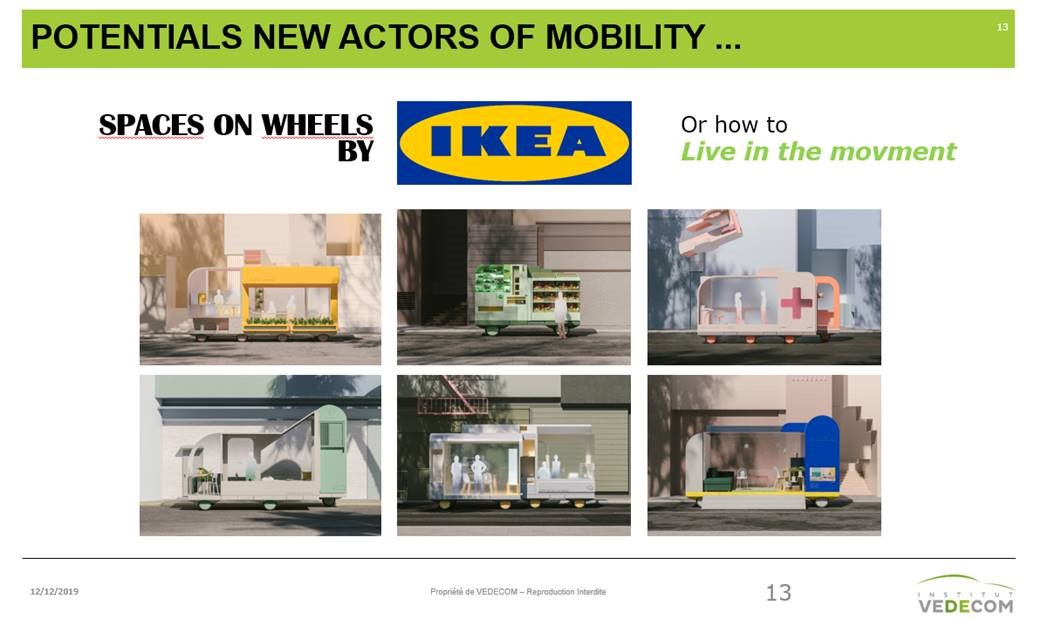
A champion of furniture for small spaces, Ikea has also jumped on board with its SPACE10 research and design lab for mobile and autonomous objects. Everywhere around us we are seeing new players whose ambition is to build the city of tomorrow, which is mobile!

Mobile hyperplaces for the city of tomorrow: issues and challenges

Redefining everyday places in this manner, through vehicles to accommodate mobile activities, is not without its challenges. It’s a challenge for less populated areas, because these kinds of activities, solutions that bring a high quality of service, are conceived with urban metabolisms in mind. It’s also a challenge for the planners who must provide new spaces for such amenities and programme activities that remain under the control of public authorities. It’s a challenge for designers: not only must our objects change, but also the spaces to accommodate them. It creates significant issues for politicians as well. It will be necessary to manage licit and illicit activities, mediate conflicts of use between mobile activities and fixed businesses, control the privatisation of public space and keep spaces from being over-used. There are economic issues too: how do we invent a new generation business models for these small-scale, very agile activities? Last but not least, it’s a societal issue, since we will need to determine how much of our space and time we want to give over to economic activity.
Watch the talk in full


Articles récents :

2019 – Acceptance levels for self-driving vehicles: a report from VEDECOM

2019 – Acceptance levels for self-driving vehicles: a report from VEDECOM

Following the “Acceptance levels for self-driving vehicles” seminar, held on 9th November 2018 at France’s Ministère de la Transition Écologique et Solidaire environmental ministry, VEDECOM was asked by the French government’s Direction Générale des Infrastructures, des Transports et de la Mer (DGITM) to produce a monograph on nationwide surveys aimed at identifying acceptance levels for self-driving vehicles. Below are the main findings of that document, which summarises and analyses the results of 9 opinion surveys and 4 scientific studies into the perception of self-driving vehicles in France.

Appreciating and understanding the current acceptance of self-driving vehicles in France

Produced by Marlène Bel, a social psychologist at VEDECOM, and Stéphanie Coeugnet-Chevrier, Director of the Institute’s “New mobility solutions and shared energies” department, the “Acceptance levels for self-driving vehicles” monograph is a report which examines nationwide surveys and studies on this issue. The purpose of this thorough investigation is to improve awareness and understanding of the issue of acceptance levels in France for self-driving vehicles in order to form a research foundation to serve the common interest. The VEDECOM institute submitted its report at the Acceptabilité du Véhicule Autonome seminar on 25th March 2019, planned and organised as part of the Stratégie Nationale du Développement des Véhicules Autonomes national strategy.

In total, some 8,500 French people were interviewed in the opinion surveys under examination, and 5,300 in the scientific studies. The objective: to assess French people’s perceptions of Level 5 self-driving vehicles in terms of security, reliability, pleasurable experience, comfort, cost, and potential to enable users to perform everyday tasks onboard. Questions regarding time and space savings, the use of personal data, the role of the supervisor and the integration of the vehicle with its surrounding environment are also considered. The studies cover not only personal and “robot taxi”-type vehicles, but also self-driving shuttles and buses.

Self-driving vehicles: a mixture of attraction and apprehension

The attractions of a self-driving vehicle – an object to inspire dreams like no other – include security, comfort and new modes of use. But its strongest resonance is in the vision of supreme freedom that it inspires. In addition to the independence and freedom of movement afforded by cars in general, it also offers the promise of extra free time and greater travelling comfort. And the promise is an emotive one: 37% of French people claim they would be keen to use a fully self-driving car because of the “extra free time” it would give them during journeys (IFOP, 2018). 74% of French people see connected cars as a way of saving time (Observatoire Cetelem, 2016); and 64% of respondents believe that the lack of impediments to their freedom of movement would encourage them to use a driverless vehicle (Débats citoyens, 2018). According to a 2018 study conducted by VEDECOM, 85% of French people would prefer to use the time inside their fully autonomous vehicles for engaging in activities other than driving or supervising their vehicle. However, security remains an issue of vital importance to users: 58% of those polled consider that the use of driverless vehicles would offer an improvement in everyday safety (Débats citoyens, 2018).

This hope of unrestricted freedom of movement is, however, tempered by a number of concerns which present obstacles to the acceptance of self-driving vehicles: according to 40% of respondents to the IFOP 2018 survey, “self-driving vehicles are rather frightening”. “The technical risk is currently too high,” according to 53% of those interviewed for the same study. In addition, questions regarding cybersecurity, responsibility and the use of personal data also present potential threats.

Trust: the key to acceptance

Although French people’s opinions on the subject are mixed, the studies do reveal a critical factor for gaining acceptance: trust. Not only trust in the technology itself, but also in its rules, usage patterns, systems and services. 53% of French people claim that “not trusting self-driving vehicles to make the right decision” is the main reason why they would be unwilling to use one (Débats Citoyens, 2018). However, studies show that trust in self-driving vehicles increases after a period of initial use. This finding is in line with the TRUST concept developed by Yann Leriche and Jean-Pierre Orfeuil in their recent work Piloter le véhicule autonome au service de la ville, co-ordinated by IVM-VEDECOM and conducted by VEDECOM. TRUST (Technologies – Rules – Uses – Systems and Services – Territories) is a trust-based methodology which offers the assurance of scientific rigour through its holistic, multi-criteria approach identifying the factors that underpin the emergence of autonomous mobility.

The monograph reveals two other key points:

  • Self-driving shuttles are generally perceived to be more acceptable than self-driving vehicles. There is a smaller paradigm shift at work in the former case than the latter: a passenger in a self-driving car is faced with a gradual transition from the role of driver of their vehicle to the role of passenger.
  • French people’s acceptance levels of self-driving vehicles are high if all the various levels of automation are factored in. When only Level 5 is considered (the assumption made in the opinion surveys), French people’s acceptance levels of self-driving vehicles are lower than average. In addition, disparities in the acceptance of self-driving vehicles emerge based on where respondents live: those who live in French cities and large towns are significantly more favourable to the concept than those who live in areas of lower density. 71% of French people living in the central Paris area would use them, compared to 40% of French people living in isolated communities outside the influence of major urban areas.


VEDECOM, a recognised expert in the acceptance of self-driving vehicles and new mobility solutions

This monograph reflects VEDECOM’s expertise in this field and acceptance levels for new mobility solutions, including self-driving vehicles in particular. This is a research area covered by the Institute’s “new mobility and shared energy solutions” division. With 50 staff working in 15 different disciplines, it addresses issues crucial to the introduction of new mobility solutions: human factors, legal frameworks, economic models for new mobility solutions, analyses of human mobility, etc. With their 45 accepted publications in a single year, these teams are active combatants on every front of the “mobility war”. 2019 was a particularly impressive year: the creation of Entropy, the first spinoff from VEDECOM, the publication of two major works in the mobility sector (Piloter le véhicule autonome, by Yann Leriche and Jean-Pierre Orfeuil, under the leadership of Mireille Apel-Muller; Véhicule autonome, qui est responsable? by Iolande Vingiano-Viricel); the awarding of the Grand Prix prize to the VEDETECT solution at the Salon des Maires fair; a strong involvement in collaborative projets: the European AutoMate project, the Paris-Saclay Autonomous Lab trial; the creation of the first certification course on legal issues pertaining to self-driving vehicles, etc.

The report on acceptance levels for self-driving vehicles which has resulted from this intense activity will be followed in 2020 by a similar work conducted by VEDECOM at international level.

For more information:

Document produced by the Stratégie nationale pour le Développement du Véhicule Autonome

Summaries:

Development of self-driving vehicles. The French strategy

Strategic approaches for public action

Articles récents :

VEDECOM’s self-driving shuttles are one year old

VEDECOM’s self-driving shuttles are one year old

On 10th December 2019, VEDECOM celebrated the first anniversary of its extended-perception self-driving shuttles operating in the Satory district of Versailles. The two vehicles serve the last kilometre of the journey for employees working on Satory’s Allée des Marronniers road, which is open to regular traffic. Here’s a review of their first year of service, demonstrations and experiments.

More than 10,000 km covered by these first extended-perception self-driving vehicles to operate on open roads in France

Having covered precisely 10,463 kilometres, VEDECOM’s self-driving shuttles Framboise and Litchi – as they are affectionately known – are now a familiar sight around the Satory area. 4,533 passengers have been carried, without incident, at speeds of up to 18.997 km/h. 81.5% of those surveyed claimed to be completely satisfied. The vehicles themselves – EZ 10 shuttles, produced using EasyMile technology – are operated by VEDECOM Tech, VEDECOM and the Paris-Saclay region, and operated by Transdev.

. It is the first extended-perception self-driving vehicle service to operate on open roads in France. The shuttles satisfy two purposes: firstly, serving passengers, whose daily mobility is improved by their “last-kilometre” coverage; and secondly, research, for which they serve as a useful tool for observation and research.

A year of continuous progress

In the year since their inauguration on 10th December 2018, the Framboise and Litchi shuttles have passed many milestones. Initially restricted to 15 km/h, they were upgraded to 18 km/h on 1st February 2019. This speed-up was closely followed by the implementation of the BlushMeUp smartphone app, offering an interface for streamlining journeys: geolocation of shuttles, viewing timetables, calculating journey times in real time, etc. The road infrastructure was also modified to adapt to these new vehicles and enable the installation of extended perception (installation of perception sensors along the roadside). Lastly, a monitoring system was set up. The shuttles now operate in “metro” mode, stopping at every station along their route. 2020 will see the development of an “on demand” mode.

Research results to benefit the deployment of future self-driving shuttles

These various improvements have yielded vitally useful information for the deployment of future self-driving mobile solutions. It was observed that the increase in speed went hand in hand with a reduction in the number of safety stops, resulting in a higher acceptance rate and service improvements. The first version of the extended-perception system has allowed possible problems to be anticipated, and is thus contributing to greater road safety.

Growing recognition

Following these progressive improvements, VEDECOM’s self-driving shuttles have also been guests at a number of events. From 4th-6th May 2019, they were on display in front of the Versailles Grand Parc local government organisation’s offices as part of the first Architecture and Landscape Biennale, organised by the Ile-de-France region. This gave the VEDECOM Tech team the opportunity to introduce the Satory district’s self-driving shuttle service to the public. And on 24th October, the Framboise shuttle was out and about again, being demonstrated at the ALD’s BlueFleet day at the Linas-Montlhéry racing circuit, alongside VEDECOM’s self-driving Zoé car. It was an opportunity for a huge audience of non-experts to see self-driving technology up close. Lastly, the shuttles were demonstrated at the Ministry of the Economy and Finance’s Cour d’Honneur in Bercy on 2nd December at the Automotive Industry Day organised by the PFA (Plateforme française de l’Automobile).

All in all, a packed first year for Framboise and Litchi… and we hope their second will be equally fruitful!


Articles récents :

VEDECOM at the controls of the ‘Autonomous Mobility’ area at ALD’s BlueFleet Day

VEDECOM at the controls of the ‘Autonomous Mobility’ area at ALD’s BlueFleet Day

On 24 October 2019 VEDECOM presented its solutions at ALD’s BlueFleet Day. The seventh edition of this key meeting in the world of vehicle fleet management took place at the Linas-Montlhéry circuit. Six different experiences were on offer to visitors for a chance to discuss and experience the challenges of the energy transition and mobility of tomorrow. VEDECOM Tech, the commercial subsidiary of VEDECOM, was responsible for running the ‘Autonomous Mobility’ area: an opportunity to do a bit of training and let Framboise navigate the urban zone of UTAC-CERAM’s brand new technology testing centre Teqmo, dedicated to connected and automated mobility.

The challenge was significant for VEDECOM at BlueFleet Day organised by ALD Automotive, the leader in long-term vehicle rental and management of vehicle fleets. It was about presenting autonomous mobility to a very wide audience who is not necessarily familiar with this type of technology. An entire area was therefore dedicated to level-4 autonomous vehicles: a VEDECOM autonomous Zoé and also Framboise, one of VEDECOM Tech’s two shuttles, usually in service in the Satory district of Versailles. Visitors were able to board one or other of the vehicles for a demonstration.

When they returned, they were set challenges in the form of quizzes to test their knowledge about the autonomous vehicle and new mobility solutions in the VEDECOM Training team’s igloo. For example: “Not counting level 0, how many levels of vehicle automation are there?” or “How many scooter companies currently operate in Paris?” This was an opportunity to show the multiple alternatives and supplements to the vehicles offer, particularly active modes of mobility.

At the end there was a talk by Guillaume Bresson, Director of Driving Delegation and Connectivity at VEDECOM, to shed some light on the autonomous vehicle, its levels of autonomy and predictions for the future according to different time frames.

An extremely beneficial day, allowing hundreds of people to see autonomous mobility up close!

Articles récents :

Demonstration of VEDECOM autonomous shuttles at Bercy

Demonstration of VEDECOM autonomous shuttles at Bercy

Notable appearances for Framboise and Litchi on Monday 2 December 2019. The autonomous shuttles were at the Ministry of Economy and Finance in Bercy for the Automotive Industry Day organised by the PFA (French Automotive Industry). VEDECOM had been invited there to perform autonomous shuttle demonstrations and present an autonomous vehicle in the courtyard at Bercy, alongside manufacturers’ latest innovations.

A day to help the automotive industry adapt to the profound changes underway

At a perilous time for the automotive industry, professionals in the field fear being stuck between the downturn in the global market and the heavy investment needed to embrace the ecological transition. This was the context behind the day organised by the PFA to give companies in the industry an insight into the main evolutions and the tools available. The aim was to help companies adapt to the profound transformations taking place. The event was held at the Ministry of Economy and Finance in Bercy and was attended by Luc Chatel, president of the PFA and Bruno Le Maire, Minister of Economy and Finance

VEDECOM and VEDECOM Tech, ambassadors of autonomous mobility

In addition to various talks, stands and new vehicles were on display in the courtyard: electric vehicles, rechargeable hybrid vehicles, hydrogen vehicles… VEDECOM and its commercial subsidiary VEDECOM Tech had a stand there with an autonomous Zoé, the delegated-driving vehicle demonstrator developed by the Institute and regularly tested on the tracks at Satory in Versailles. Framboise and Litchi, EasyMile’s two EZ10 autonomous shuttles with wide perception, implemented by VEDECOM Tech, were used on Allée Jean Monnet to transport visitors through the building complex from the entrance gate to the courtyard. In keeping with its mission, the Training team offered an autonomous vehicle quiz to put everyone’s knowledge to the test.

Focus on VEDECOM’s research activity regarding autonomous mobility

The Institute devotes one of its three R&D domains to driving delegation and connectivity with more than 60 employees across 15 different disciplines. Generating enriched data to validate the autonomous vehicle, multi-sensory perception and decision systems to navigate the autonomous vehicle, reliable and low-latency communication for smart mobility or smart sensors and infrastructure for the connected vehicle… The major strategic approaches deployed by VEDECOM address a variety of themes covering all issues related to the autonomous vehicle.

The Institute is also working on five national projects including the Paris-Saclay Autonomous Lab project, and the SAM project for safety and acceptability of the autonomous vehicle, for which it provides project management. It is also involved in 10 European projects, including Autopilot, AutoMate and Headstart.

Articles récents :

VEDECOM at the “Engineering Complex Preponderant Software Systems” seminar given by the DGA-TA

VEDECOM at the “Engineering Complex Preponderant Software Systems” seminar given by the DGA-TA

Gilles Le Calvez, VEDECOM’s Head of Validation and Approvals in Autonomous Mobility, was invited to attend the seventh “Engineering Complex Preponderant Software Systems” seminar, which took place in Toulouse on 16 and 17 October 2019.

He gave a presentation of VEDECOM’s activities in the field of autonomous vehicles, including the MOOVE project. The aim of this project is to make autonomous driving safer by collecting massive amounts of driving data; a business in touch with artificial intelligence, well-placed to contribute to the development of secure software for the automotive sector. This involvement attests to the Institute’s expertise in the development of ground-based autonomous systems, and its place within the French industrial landscape of artificial intelligence.

The event, organised every two years by the Aeronautical Techniques arm of the French defence procurement agency (DGA-TA), gathered together some 300 participants (Ministry of the Armed Forces, institutional and industrial stakeholders within the defence sector) based around the theme of “Impact of new technologies on operating safety and software engineering”. The Ministry of the Armed Forces centre of technical expertise for aeronautical issues had set the key focus of these two days of discussion as the qualification and certification of artificial intelligence alongside its impact on new technologies, their operating safety and embedded software engineering.

Articles récents :